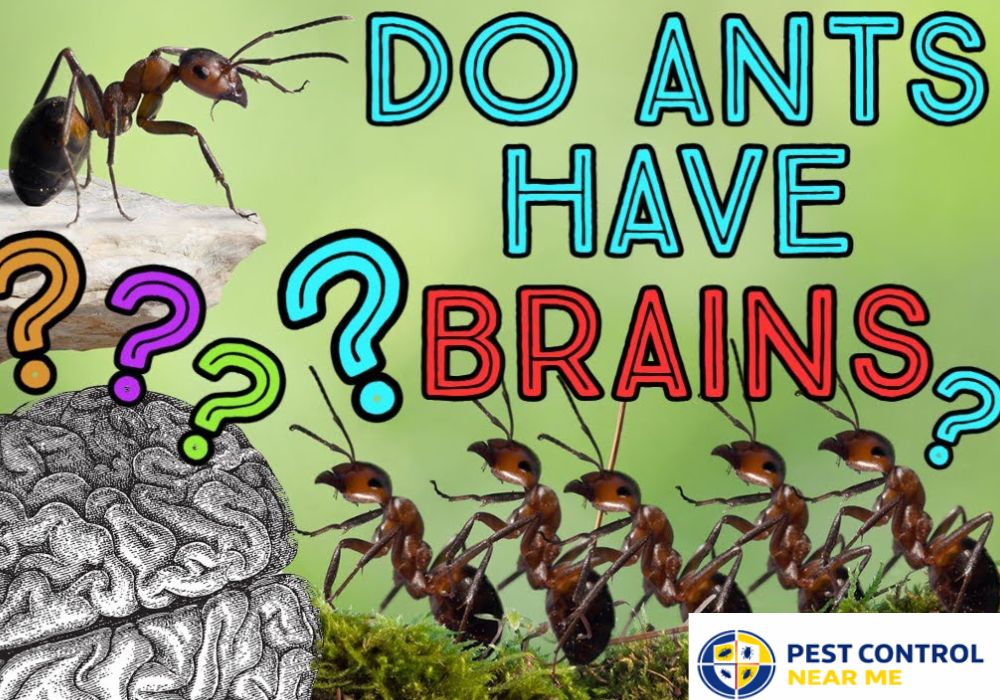
If you’ve ever wondered, do ants have brains? The answer is yes—but not in the way you might expect. Ants have extremely tiny yet highly structured brains with roughly 200,000–250,000 neurons. While this is very small compared to humans, their nervous system is incredibly efficient for their size, giving them one of the highest brain-to-body ratios among insects.
On their own, ants have limited intelligence, but when they function as a colony, they display what scientists call collective intelligence. This allows them to solve problems, organize tasks, and respond to threats together like a single living system. Ants mainly communicate through pheromone trails, along with touch and vibrations, which acts as a biological messaging system within the colony. Read our latest post on How Many Legs Do Ants Have? Ant Life Cycle & Types
Do Ants Have Brains?
Yes, ants do have brains located in their heads. These brains control essential functions such as movement, learning, memory, and navigation. Despite their size, ants can recognize nestmates, remember food locations, and adapt to environmental changes. A single ant may not seem intelligent, but as a group, they can construct complex tunnel systems and manage organized colonies without any central leadership.
How Big Is an Ant’s Brain?
| Species | Approximate Neurons | Notes |
| Human | ~86 billion | Complex reasoning |
| Mouse | ~70 million | Mammalian cognition |
| Honeybee | ~1 million | Advanced navigation |
| Ant | ~250,000 | Colony-based intelligence |
Even with far fewer neurons, ants perform impressive tasks like farming fungi, protecting resources, and coordinating large groups for survival.
How Intelligent Are Ants?
Ant intelligence lies in teamwork rather than individual thinking. Ant colonies operate using swarm intelligence, meaning there is no single leader directing activities. Each ant follows simple rules based on environmental signals, but together they form efficient systems that can locate food, defend their nest, adjust roles within the colony, and even relocate when necessary. This shared intelligence helps colonies behave as one coordinated unit.
Read More: Baby Termites vs Ants? How to Tell the Difference & Signs of Infestation
How Do Ants “Talk” to Each Other?
Ants communicate mainly through pheromones, which are chemical signals they leave behind. When one ant finds food, it releases a pheromone trail so others can follow the path. Ants also communicate through touch using their antennae and, in some species, through subtle vibrations that travel through surfaces. These methods allow ants to share information without using sound in the traditional sense. last week, we published a post on Is Pest Control Safe for Pets? What Pet Owners Need to Know in 2026
Final Thoughts
So, do ants have brains? Yes—and surprisingly efficient ones. Although individual ants have limited thinking ability, their true intelligence becomes evident when they work together as a colony.
Through chemical signals, touch, and coordinated behavior, ants are able to adapt, organize, and solve problems as a group. They may not think or feel like humans, but their cooperative systems make them one of nature’s most fascinating examples of shared intelligence.
FAQs About Do Ants Have a Brain?
Do ants feel any pain?
Ants can detect harmful stimuli using sensory receptors, but scientists are unsure whether they experience pain in the emotional sense like humans. Their responses are believed to be instinctive rather than emotional.
Do ants have thought?
Ants do not think in the same way humans do. However, they can learn from experience and remember routes or food sources through simple memory processes.
What is the IQ of ant?
IQ is a human measurement and cannot be applied to ants. Their intelligence is best understood through their ability to work collectively as a colony.
Why should we not squish ants?
Squishing ants can release alarm pheromones that signal danger to other ants, potentially attracting more ants to the same area.
Why do 30% of ants do nothing?
Some ants appear inactive because they act as backup workers. These reserve ants can quickly replace active workers if needed, helping the colony survive.
Why are ants so painful?
Certain species, such as fire ants, inject venom when they sting, which causes a burning or itching sensation.
Why do ants rip their queen apart?
Worker ants may kill their queen if she becomes weak or stops producing enough eggs to ensure the colony’s survival.
Why do ants stop when you draw a line?
Some substances can disrupt pheromone trails, temporarily confusing ants and interrupting their movement.
Do ants have feelings?
There is no scientific evidence that ants experience emotions like humans do. Their behavior is driven by instinct and chemical signals.